
Patented by Guidi in 1982 and improved ever since without changing its principle, the Mediterraneo is a straight-through seawater strainer: water enters on one side and leaves on the other, cleaned of debris before it reaches the engine heat exchangers, the generator or the air conditioning. Here is what you need to know to choose, install and maintain it, based on the manufacturer's GuidiLAB page, with the references available from us.
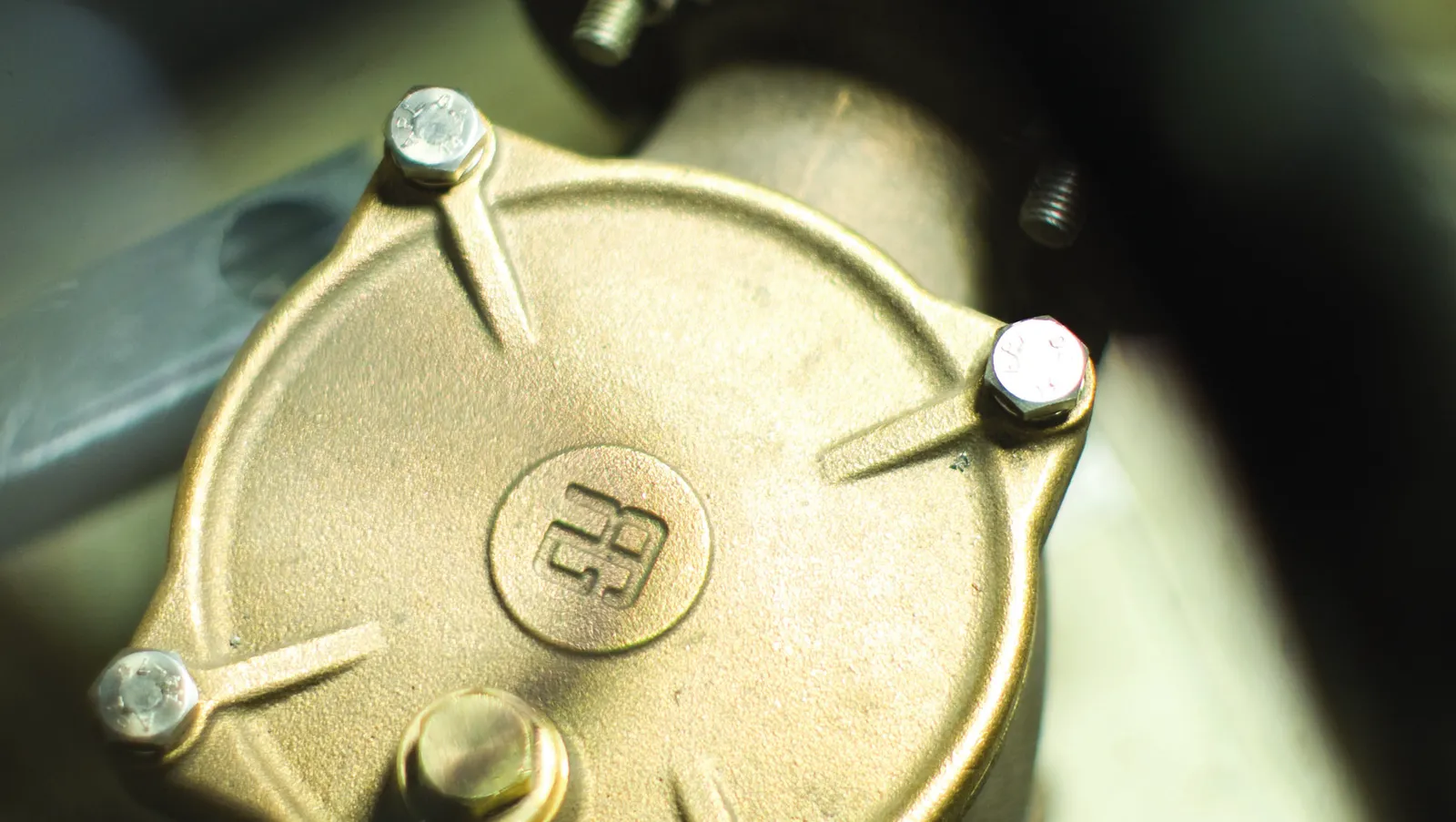
Mediterraneo versions
Guidi offers two lids and two materials:
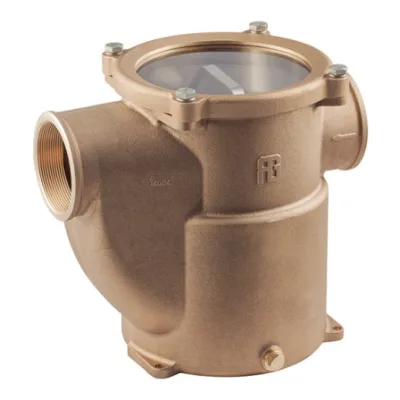
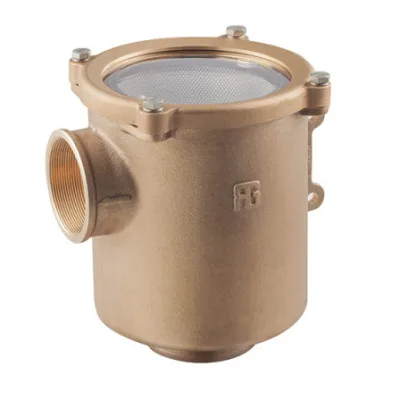
- with a clear polycarbonate disc: item 1162 in bronze (3162 in black anodised aluminium);
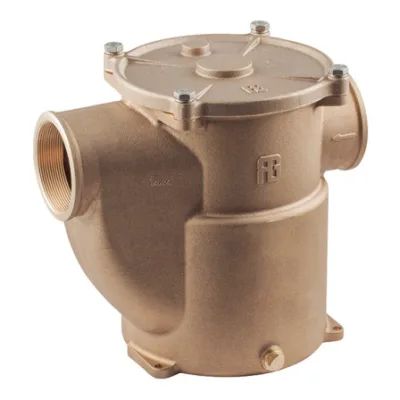
- with a metal lid: item 1163 in bronze (3163 in black anodised aluminium).
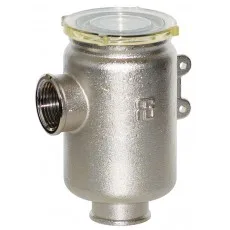
At RPM Diffusion, both nickel-plated bronze versions are available from DN10 (3/8") to DN100 (4"), rated PN6.
What is it for?
It is the choice when water must flow straight through the strainer. It filters the incoming seawater and delivers it clean to engine heat exchangers, generators and air conditioning. It is found in the engine rooms of pleasure boats and commercial vessels alike, as well as in swimming pools, quarries and water networks. It is not, however, intended as a fuel pre-filter.
Bronze or aluminium?
Bronze offers the best corrosion resistance. Guidi advises building the whole circuit in the same material (intake, valve, fittings, outlets) rather than mixing metals. Aluminium is used to save weight, with the same rule: no mixing, to avoid galvanic corrosion. The topic is covered in detail in our article on seawater circuit materials.
A shape designed for flow
The bottom of the body is rounded: this “belly” reduces head loss at the outlet, smooths the flow and limits air bubbles. To get the most out of it, Guidi recommends pairing it with its patented intakes (items 1112B, 1113B, 1260, 1260A, 1261 and 1262), as the whole circuit is designed to reduce head loss and prevent air and cavitation.
Cavitation is the formation of vapour pockets in the water when pressure drops locally. As these bubbles collapse, they produce very high-pressure micro-jets: noise, loss of efficiency and, over time, pitting on metal surfaces. Head losses are the pressure drops caused by friction: distributed along the pipes, or local at each elbow, reducer, valve or strainer. They are used to size pipework and choose pumps.
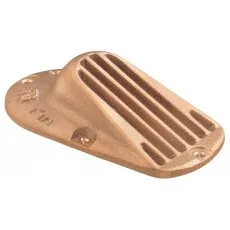
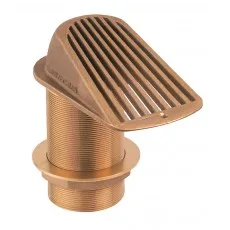
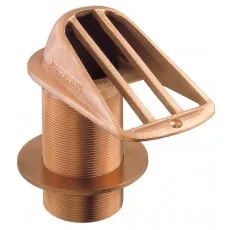
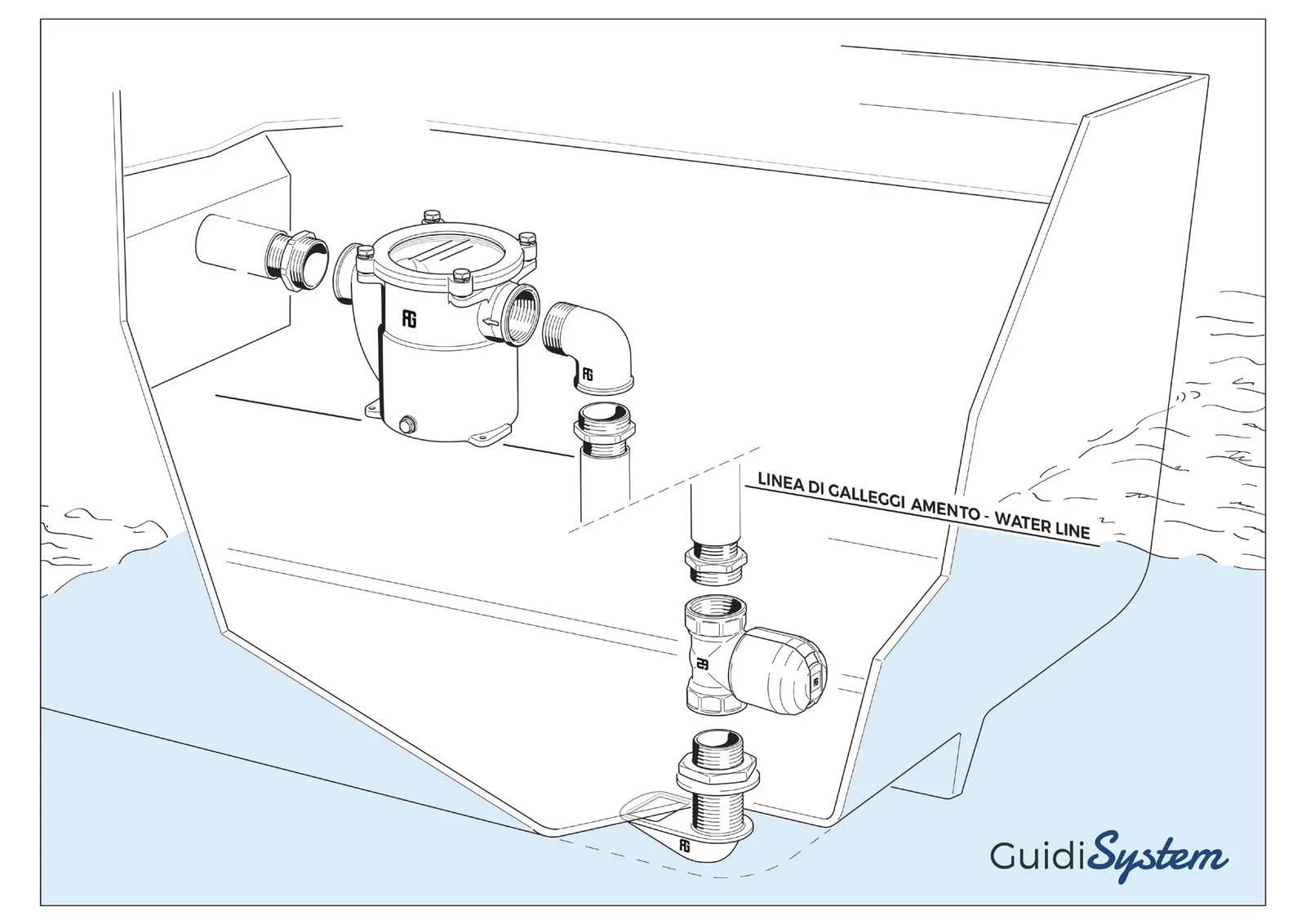
The complete installation, from intake to engine, is described in our article on the Guidi System C-PIN.
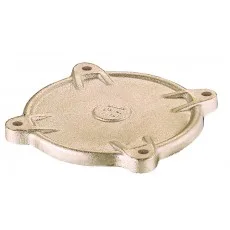
Polycarbonate disc or metal lid?
The polycarbonate disc (Lexan) lets you see inside the strainer without opening it. It suits pleasure boats and some civil uses: the material withstands impacts and temperature changes and has good elasticity. For extreme conditions, such as polar regions, Guidi recommends the metal lid. The metal lid is intended for commercial and work vessels. The choice also depends on the approval rules that apply to the boat.
The lid is closed with hex-head screws, using a standard spanner. Indicative tightening torques given by Guidi:
| Strainer size | Tightening torque |
|---|---|
| 3/8" to 1/2" | about 4 Nm |
| 3/4" to 1"1/2 | about 6 Nm |
| 2" to 4" | about 9 Nm |

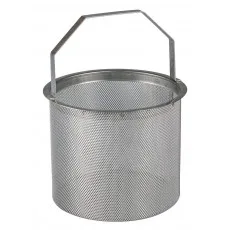
The 316L stainless steel basket
The filter basket is made of 316L stainless steel, suited to seawater. For this grade Guidi gives a PREN of 25 to 28, better resistance to electrolytic corrosion than 304 stainless, and a carbon content below 0.035% (against up to 0.080% for standard 316). If a basket corrodes, the problem usually lies in the installation: the basket is acting as a sacrificial anode. Check the cathodic protection and the bonding.
Seals and drain
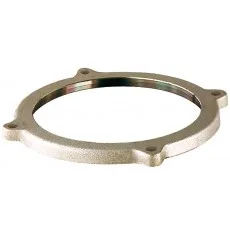
Two neoprene O-rings, a synthetic rubber that resists salt water, keep the strainer watertight: one for the lid, one for the drain plug. The drain empties the water left in the body when the intake valves are closed or the boat is out of the water; it opens with an adjustable or socket spanner.
Which size?
The size depends on the installation: the engines served, how many circuits one strainer supplies and the acceptable head loss. Guidi warns against oversizing. If in doubt, send us your circuit details.
Testing, approvals and service life
Raw materials are checked before production, then dimensions, assembly and packaging during it. At the end of production, every part undergoes a pressurised air leak test, with an internal certificate. Hydrostatic tests are also carried out under the supervision of external bodies, using oil-emulsified water, white in colour, which makes leaks easy to spot. Guidi states that its Mediterraneo strainers are approved by RINA and Lloyd's Register, whose rules follow IMO principles. If your boat requires an approval, ask us for the certificate matching the chosen reference and lid.
The strainer is easy to dismantle: any part can be replaced without changing the whole strainer. At the end of its life, it is almost entirely recyclable.
Mediterraneo, Ionio or Tirreno?
- Mediterraneo: straight-through flow, from one side to the other.
- Ionio: water enters from the bottom and leaves from the side, at a right angle.
- Tirreno: a compact version of the Ionio for small engines and generators where space is tight; available in nickel-plated brass or bronze, with a different lid closure.
See all our seawater strainers.
Installation: the rules to follow
- Follow the flow direction shown by the arrows.
- Fix the strainer's feet with the strainer horizontal, leaving room to lift out the basket.
- Connect the strainer to the boat's bonding system so that no galvanic current flows through the basket.
- Always fit it above the waterline: this is a passive safety measure, for example if the lid is not refitted after servicing.
- On a new circuit, check the basket after a few hours of running to remove debris from the new pipework.
Step-by-step maintenance
- Stop the engine and close the intake valves.
- Open the strainer and lift out the basket.
- Wash it with water and compressed air; scrape off any encrusted areas if needed. Baskets clog with fouling, but also with litter and plastics carried by the sea.
- Check the seals and replace them only with genuine parts.
- Reassemble, then check the screw tightening (see the table above).
- Only then reopen the intake valves.
Safety: never reopen the intake valves before the lid is closed, or the boat may flood. A leaking or damaged lid, or a disc that has turned opaque after contact with a chemical, must be replaced together with its O-ring. Nuts can be bought from a hardware store, but they must be low-carbon A4 austenitic stainless steel. Note that changing the type of lid changes the approval.
The antifouling kit
For areas heavily exposed to marine fouling, Guidi has developed an antifouling kit (guidisrl.it) with Tecnoseal. Its aim: stop fouling from spreading in the seawater circuit and reduce maintenance.
Frequently asked questions
Can the Mediterraneo strainer be fitted below the waterline?
Guidi recommends always fitting it above: if the lid is forgotten or badly closed after servicing, water cannot flood the boat.
Polycarbonate disc or metal lid?
The disc lets you see the basket without opening the strainer, on pleasure boats and for some civil uses. The metal lid is intended for commercial vessels and extreme conditions. The choice also depends on the boat's approval rules.
Why is the stainless steel basket in my strainer corroding?
Usually because of the installation: the basket is acting as a sacrificial anode. Check the strainer's bonding and the cathodic protection.
What torque should the lid screws be tightened to?
About 4 Nm from 3/8" to 1/2", 6 Nm from 3/4" to 1"1/2 and 9 Nm from 2" to 4", according to Guidi's indicative values.
Is the Mediterraneo strainer suitable for fuel?
No: it is designed for seawater and is not intended as a fuel pre-filter.
Find out more
Browse all Guidi products at RPM Diffusion and the manufacturer's page: Mediterraneo series water strainer, GuidiLAB (guidisrl.it). To choose the right size or obtain a certificate, call us on +33 4 22 32 91 88 or email contact@rpmdiffusion.com.