
A ball valve opens and closes with a quarter turn, but in seawater its materials matter as much as its principle. The Guidi 2300 series is the manufacturer's family of bronze ball valves for marine use, in three versions: the threaded, lever-operated 2300, the flanged 2350US and the motorised 2300AE. All three share the same CC499K bronze body, the same internal construction and the same full bore. Here is what sets them apart, based on the manufacturer's GuidiLAB page and technical data sheet.
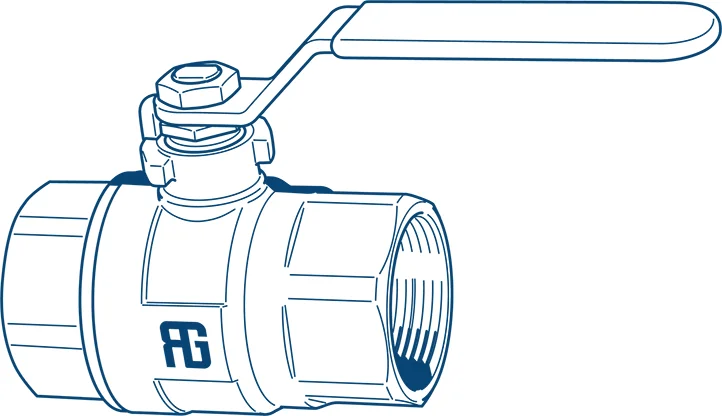
Why a CC499K bronze body?
Guidi points out that CC499K bronze resists marine corrosion much better than brass, which is far more vulnerable to dezincification and to degradation in high-salinity environments. This bronze forms the body and body end of all three versions. On choosing materials for a seawater circuit, see our article Bronze, brass, stainless steel, aluminium.
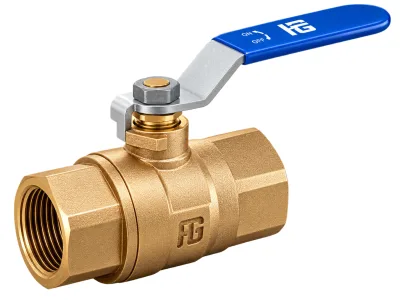
The 2300 valve in detail
- Body and body end in CC499K bronze.
- Brass ball with anti-scale surface treatment.
- Coated brass stem, blow-out proof.
- PTFE seats and gland washer, EPDM O-ring.
- AISI 304 stainless steel lever and lever nut.
- Full bore, female-female BSPP thread to EN 10226-1 (BS 21).
- Nominal pressure PN16 (16 bar) across the whole range, from 3/8" to 3".
We offer it in nine sizes, from 3/8" to 3":
| Reference | Size |
|---|---|
| RPM2300-03 | DN10 - 3/8" |
| RPM2300-04 | DN15 - 1/2" |
| RPM2300-05 | DN20 - 3/4" |
| RPM2300-06 | DN25 - 1" |
| RPM2300-07 | DN32 - 1"1/4 |
| RPM2300-08 | DN40 - 1"1/2 |
| RPM2300-09 | DN50 - 2" |
| RPM2300-10 | DN65 - 2"1/2 |
| RPM2300-11 | DN80 - 3" |
Approvals
The 2300 holds a RINA type approval certificate (no. DIP235223CS/003, reference standard ISO 9093:2020) and a Lloyd's Register type approval certificate (LR2556185TA-01). According to Guidi, this allows it to be fitted on boats up to 24 m hull length, measured to ISO 8666, and on classed ships. The 2350US is approved by Lloyd's Register and designed to comply with the American ABYC H-27 standard; the 2300AE's approval is based on that of the 2300.
The flanged 2350US
The 2350US uses the materials and internal parts of the 2300 on a flanged body, with holes at 120° for fixing directly to the hull or to a backing plate. This makes it suitable for installations to American standards: NPS/NPT thread to ASME B1.20.1, with gas (BSP) thread available from Guidi on request, from 3/4" to 2", PN16. The data sheet adds:
- an ergonomic swivel lever in 304 stainless steel, with square hole;
- a drain and inspection plug;
- a grease fitting;
- a bonding point;
- compatibility with UNI EN 1092 flanges.
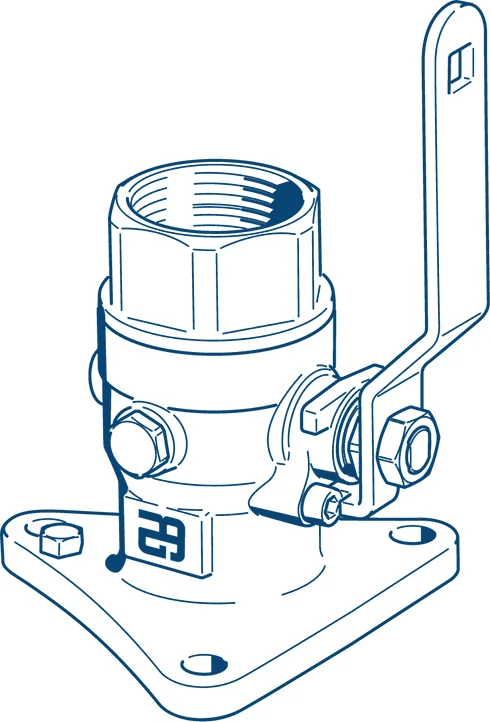
The motorised, plug-and-play 2300AE
The 2300AE is an electric actuator that fits on the body of a 2300 valve in place of the lever, without removing the valve from the installation: a valve already in place can therefore be motorised without replacing it. The 304 stainless steel lever stays on the actuator body and always allows manual operation, even without power.
- 12 V or 24 V DC power supply.
- 5-20 mA integration signals.
- Built-in position sensors with open/closed feedback.
- Adjustable opening and closing times; the faster the operation, the lower the torque.
- Wiring diagram screen-printed on the housing.
- From 1/2" to 1"1/2, PN16.
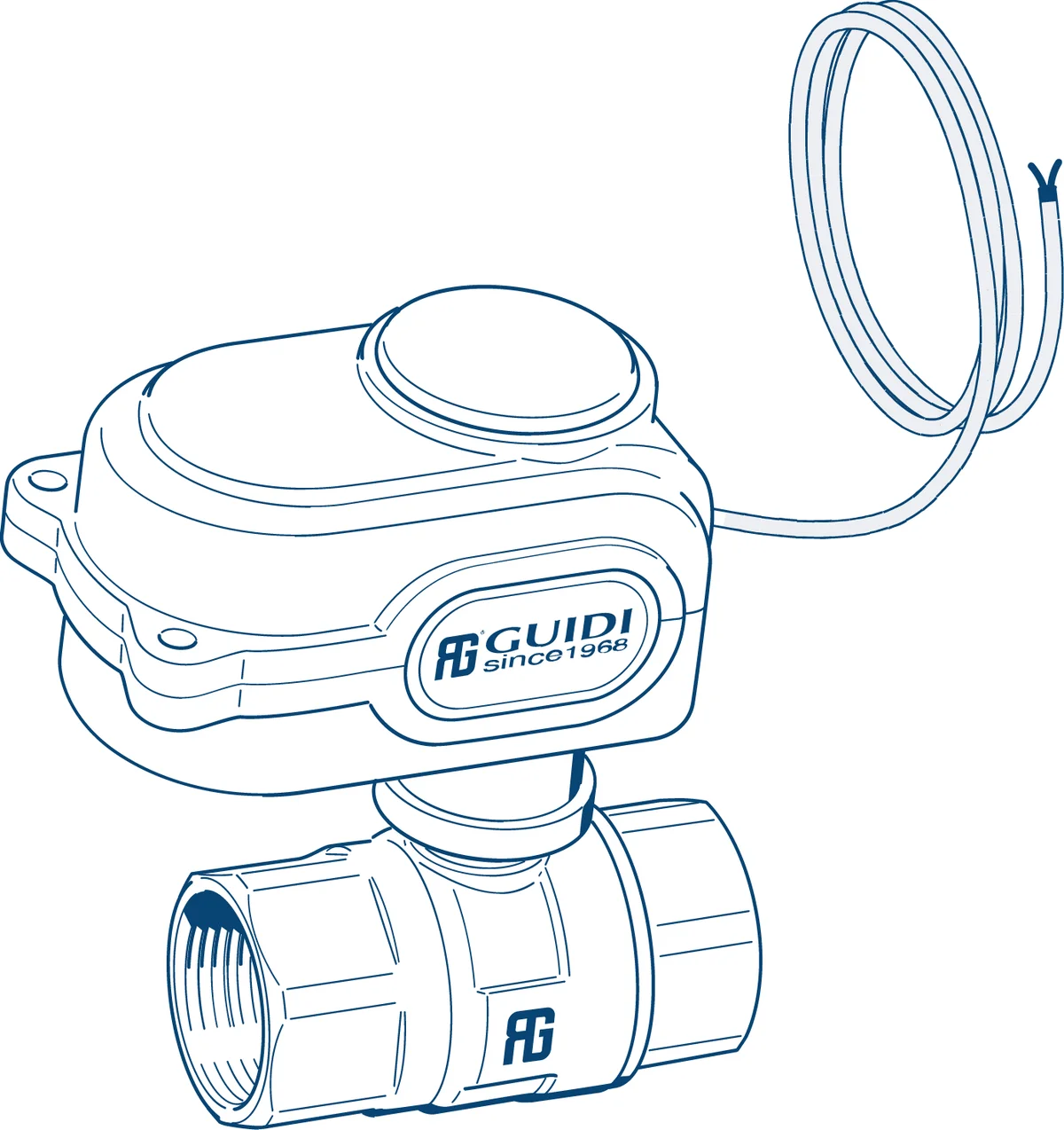
To control a whole seawater intake remotely, Guidi also offers a motorised anti-blocking valve as part of its connected system: see our article on the Guidi System C-PIN.
The 2350US and the 2300AE are not in our online catalogue: contact us to discuss them.
Spare parts
Guidi supplies a stainless steel lever and nut kit, KIT2300, for all sizes from 3/8" to 3". It is not in our online catalogue: contact us with your valve size.
Ball valve or anti-blocking valve?
Our article on anti-blocking valves explains why ball valves designed for building services and industry end up seizing on board when nobody operates them. The 2300 series, by contrast, is designed for marine use: CC499K bronze body, anti-scale treated ball, PTFE seats. For valves that sit unused for months, Guidi patented a different solution, the anti-blocking valve, whose mechanism is isolated from the water by a neoprene membrane. To choose for your installation, talk to us.
Around the valve
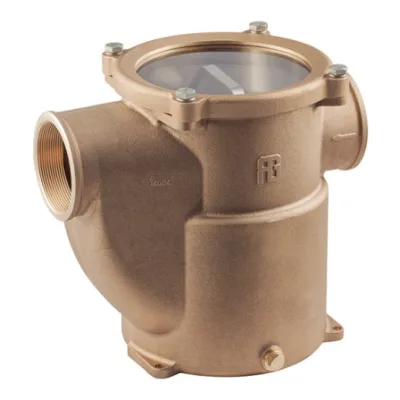
To build the seawater line, from through-hull to strainer (see also our articles on seawater intakes and the Mediterraneo strainer):
Safety: all work on a seacock must be done with the boat out of the water or with the intakes closed from outside. If water gets in during the work, the boat can flood and sink.
See all our threaded ball valves.
Frequently asked questions
What sizes are available in the 2300 series?
The threaded 2300 runs from 3/8" to 3", the flanged 2350US from 3/4" to 2", the motorised 2300AE from 1/2" to 1"1/2. All are PN16 (16 bar).
Why bronze rather than brass?
According to Guidi, CC499K bronze resists marine corrosion much better than brass, which is far more vulnerable to dezincification and to degradation in high-salinity environments.
Is the 2300 valve approved?
Yes: RINA type approval DIP235223CS/003 (ISO 9093:2020) and Lloyd's Register type approval LR2556185TA-01. It can be fitted on boats up to 24 m hull length (ISO 8666) and on classed ships.
Can an installed 2300 valve be motorised?
Yes: the 2300AE actuator fits on the valve body in place of the lever, without removing it from the installation. The stainless steel lever stays on the actuator for manual operation.
Which thread do the 2300 and 2350US have?
The 2300 has a BSPP thread to EN 10226-1 (BS 21). The 2350US has an NPS/NPT thread to ASME B1.20.1, with gas (BSP) thread available from Guidi on request.
Find out more
Browse all Guidi products at RPM Diffusion, the manufacturer's page (2300 series ball valves, GuidiLAB) and its data sheet (PDF). To choose a size or ask about a version not in the catalogue, call us on +33 4 22 32 91 88 or email contact@rpmdiffusion.com.