
A press fitting joins two pipes without a flame or a thread: the pipe is pushed into the fitting, then a pressing tool fitted with jaws deforms the fitting onto the pipe and compresses the O-ring seated inside. At RPM Diffusion we offer two complete families of press fittings and pipes: AISI 316L stainless steel and 90/10 copper-nickel (some references contain IP or CUNP, e.g. RPM0270IP, RPM0130CUNP), from Ø15 to Ø108, mostly PN16, with the M press profile. This guide explains the principle, helps you choose the material and presents the matching pipes, fittings and valves.
How does a press fitting work?
Each end of the fitting finishes in a bead that holds an O-ring. The pipe is pushed into the end, then the tool closes its jaws around the bead: the fitting deforms onto the pipe, holding it mechanically, and the O-ring, compressed all the way round, provides the seal.
- No hot work: no torch and no welding, so no fire risk from a flame during installation.
- A required jaw profile: our fittings use the M profile, where the bead, at the end of the fitting, is compressed around its whole circumference. Jaws from different systems are not always compatible, and the wrong profile can reduce the permissible pressure and the strength of the joint.
- A risk to be aware of, the unpressed fitting: a fitting that has only been pushed on can seem tight, pass a pressure test, then pull apart in service. Check every fitting before filling the system.
Stainless steel or copper-nickel: which material should you choose?
The short answer: copper-nickel for seawater, stainless steel for fresh water, heating, cooling and compressed air. This is what the specifications on our product pages show: seawater is listed among the applications of the copper-nickel fittings, not of the stainless steel ones. Both families have the same maximum pressure and the same press profile; they differ in material, O-ring and temperature range.
| AISI 316L stainless steel | 90/10 copper-nickel | |
|---|---|---|
| Fitting material | AISI 316L austenitic stainless steel (1.4404) | 90/10 copper-nickel CuNi10Fe1.6Mn (WL 2.1972) |
| O-ring | Black EPDM | Green FKM |
| Service temperature | -20 °C to +120 °C (-30 °C occasionally) | -20 °C to +220 °C; in seawater -20 °C to +120 °C |
| Maximum pressure | 16 bar (PN16); PN6 for a few parts | 16 bar (PN16); PN6 for a few parts |
| Stated applications | Drinking water, heating, cooling and refrigeration, treated water, desalinated water, rainwater, compressed air (classes 1 to 4) | Naval, seawater, compressed air (class 5), oil and diesel fuel, solar |
| Press profile | M | M |
| Diameters | Ø15 to Ø108 | Ø15 to Ø108 |
90/10 copper-nickel is an alloy of copper and nickel with a little iron and manganese. It is known for its very good resistance to saltwater corrosion and its natural resistance to marine fouling, which is why it is used for seawater piping, heat exchangers and condensers. Its performance depends on staying below the design flow velocity, and it corrodes faster in polluted or stagnant seawater containing sulphides or ammonia. On choosing materials for a seawater circuit, see also our article Bronze, brass, stainless steel, aluminium.
Which pipes go with these fittings?
The fittings are installed on thin-walled pipes designed for pressing, in the same material and with the same outside diameter:
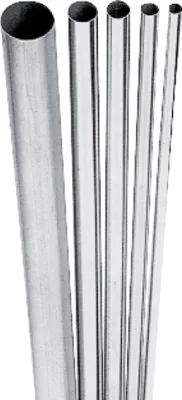
- AISI 316L stainless steel pipe (RPM49): thin-walled, longitudinally welded pipe in 1.4404 steel, to EN 10217-7 (DIN 17455) and EN 10312 and to DVGW worksheet GW 541. Supplied in 6 m lengths with capped ends, from Ø15 to Ø108.
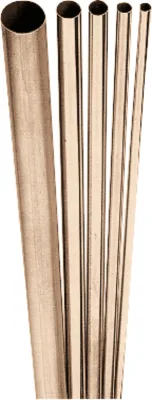
- 90/10 copper-nickel pipe (RPM4663): seamless thin-walled pipe in CuNi10Fe1.6Mn, to DIN 86019, non-combustible (class A), supplied in 6 m lengths, from Ø15 to Ø108.
Copper-nickel pipe wall thicknesses:
| Outside diameter | Wall thickness (mm) |
|---|---|
| Ø15 | 1 |
| Ø18 | 1 |
| Ø22 | 1 / 1.5 |
| Ø28 | 1.5 |
| Ø35 | 1.5 |
| Ø42 | 1.5 |
| Ø54 | 1.5 |
| Ø76.1 | 2 |
| Ø88.9 | 2 |
| Ø108 | 2.5 |
Which press fittings are available?
Our press ranges cover a complete system, from a straight joint to connecting equipment:
- Couplings: short coupling to join two pipes, and longer full-bore coupling for an unrestricted flow.
- Changes of direction: 90°, 60°, 45°, 30° and 15° elbows, female-female or male-female, bends, crossover bends.
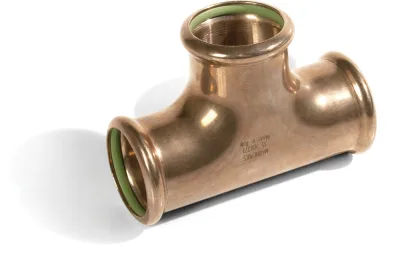
- Branches and reductions: equal tees, reducing tees, reducers.
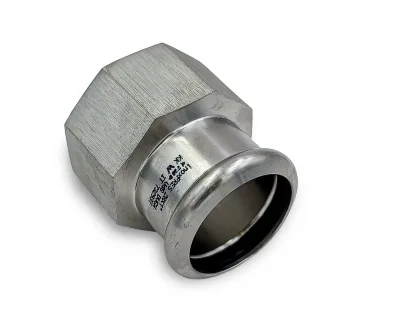
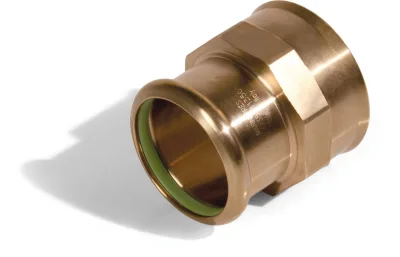
- Threaded transitions: female-female and female-male straight adaptors, threaded tees, unions; the thread is to EN 10226-1 (formerly ISO 7/1).
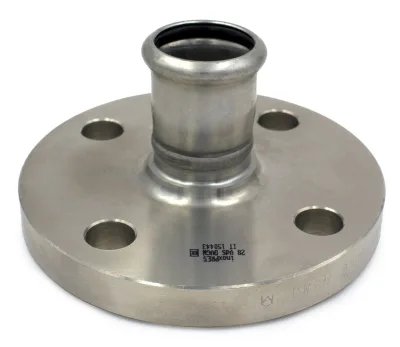
- Flanged transitions: flanged adaptors and stub ends (collars); some stub ends and flanged adaptors are PN6: see the product page.
- Accessories: bulkhead fittings, end caps.
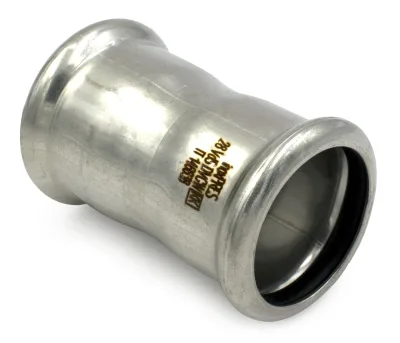
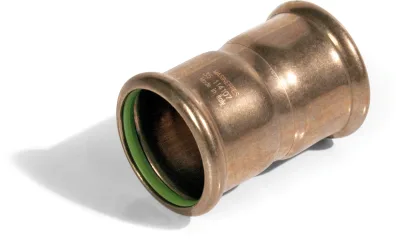
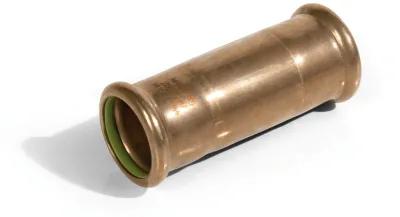
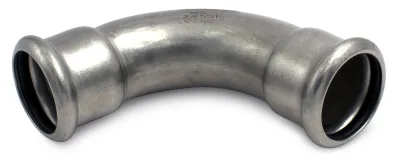
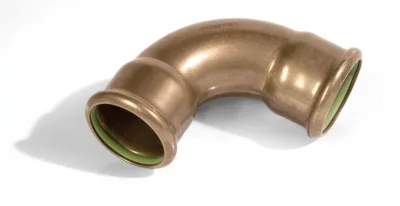
To connect a pump, a strainer or a threaded valve, the straight press adaptors run from Ø15 - 1/2 inch to Ø54 - 2 inches:
Are there press-end valves?
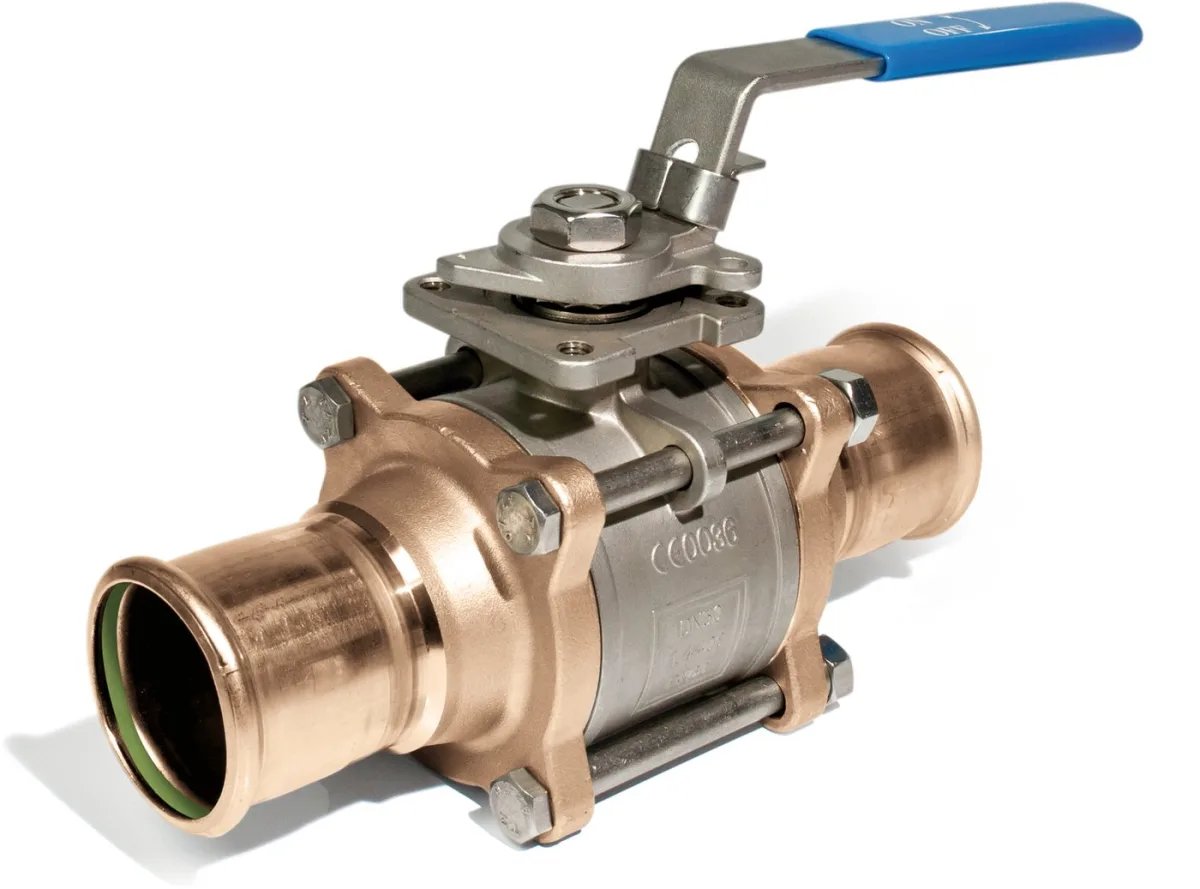
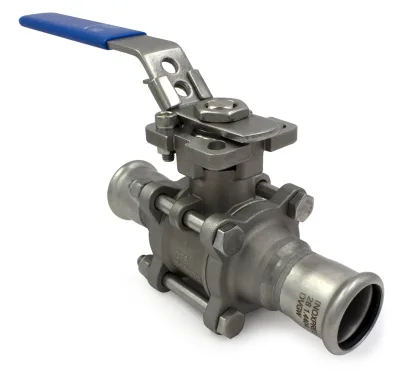
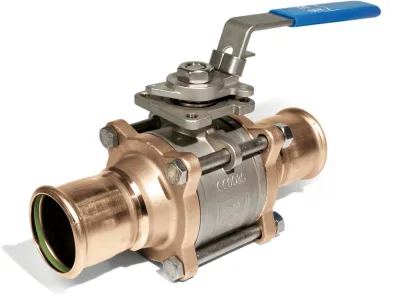
Yes, in both materials and from Ø15 to Ø108: the valve fits directly into the system, with no threaded transition. The page for the stainless steel ball valve shows AISI 316L (1.4404) for most of its parts and PTFE for one of them. The three-piece ball valve listed as copper-nickel has copper-nickel press ends with FKM O-rings; its page also shows AISI 316L (1.4404) for some parts, and its centre body is stainless steel. We also offer press-end check valves.
What tooling do you need?
A pressing tool, manual or powered, fitted with M-profile jaws matching the fitting diameter; for large diameters, pressing chains are used. We have no pressing tools in our online catalogue: contact us to discuss before starting a job.
Are these fittings certified?
The product pages show Lloyd's Register and RINA for almost all our press fittings, pipes and valves; a few variants show only one or none (e.g. the Ø22 x 1.5 mm copper-nickel pipe, Lloyd's only). The mention can vary from one variant to another, and it does not replace the document: for a classed ship or a job that requires it, confirm with us, before ordering, which certificate will be supplied. Our Certifications page (in French) explains what these mentions mean.
How do you get the installation right?
- Do not mix ranges: stainless steel pipe with stainless steel fittings, copper-nickel pipe with copper-nickel fittings, at the same outside diameter.
- Take the O-ring into account, as it sets the temperature range and the fluids allowed: the O-ring shown on the product pages is black EPDM on stainless steel and green FKM on copper-nickel; check the page of the reference you choose.
- Use M-profile jaws of the right diameter.
- Check that every fitting has been pressed before the pressure test and commissioning.
Safety: if the system is connected to a seawater intake, all work must be done with the boat out of the water or with the intakes closed. If water gets in during the work, the boat can flood and sink.
Frequently asked questions
What pressure and temperature can these press fittings take?
16 bar maximum (PN16) for most of both ranges; some stub ends and flanged adaptors are PN6. Stainless steel with EPDM O-ring: -20 °C to +120 °C. Copper-nickel with FKM O-ring: -20 °C to +220 °C, and -20 °C to +120 °C in seawater.
Can stainless steel press fittings be used in seawater?
Our product pages do not list seawater among the applications of the stainless steel fittings; they do list it for copper-nickel. For a seawater system, choose the copper-nickel range.
Which diameters are available?
Ø15, Ø18, Ø22, Ø28, Ø35, Ø42, Ø54, then Ø76 and Ø88 (Ø76.1 and Ø88.9 on the copper-nickel pipes and couplings), then Ø108, in both materials, with the matching pipes.
Do you need a special tool for pressing?
Yes: a pressing tool with M-profile jaws matching the diameter. We do not offer one in our online catalogue; contact us to discuss it.
Do these fittings and pipes have classification society certificates?
Our product pages show Lloyd's Register and RINA for almost all references; a few variants show only one or none (e.g. the Ø22 x 1.5 mm copper-nickel pipe, Lloyd's only). Check the variant on the product page and confirm with us, before ordering, which document will be supplied.
Find out more
Browse all our press fittings, stainless steel pipes, copper-nickel pipes and press-end ball valves. To choose a material, a diameter or tooling, call us on +33 4 22 32 91 88 or email contact@rpmdiffusion.com.